Beyond the Algorithm: How a New Generation of Artists Is Building Culture From the Inside Out
Photo: Stefano della Bella / Israël Henriet, CC0, via Wikimedia Commons
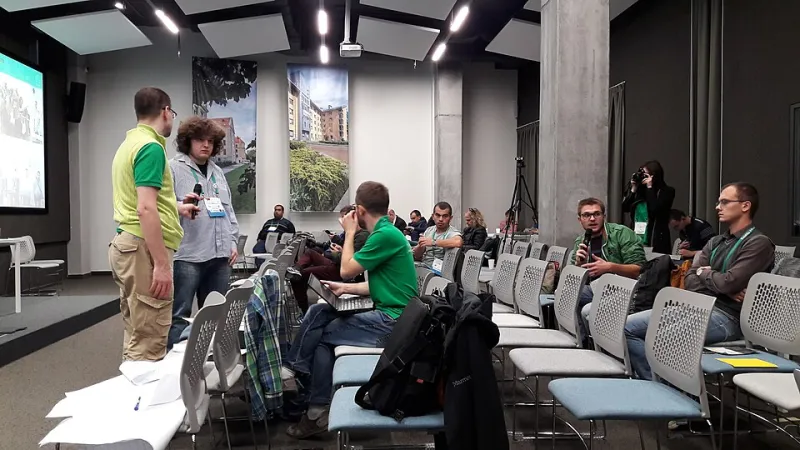
Somewhere in a converted warehouse in Richmond, Virginia, a twenty-three-year-old filmmaker named Deja Okonkwo is editing her second short film on a laptop propped up by a stack of library books. She has no distribution deal, no agent, and no interest in acquiring either. What she does have is a Discord community of four thousand people who followed her first film from concept to completion, contributed to its crowdfunding campaign, and showed up — physically — to its screening at a neighborhood community center.
"I didn't make this film for a festival jury," Okonkwo says, not with defiance but with a kind of quiet clarity. "I made it for the people in my neighborhood who never see themselves in anything that calls itself art."
Okonkwo is not an anomaly. Across the United States, a generation of artists born in the late 1990s and early 2000s is reshaping what American cultural production looks like — not by storming existing institutions, but by building entirely different ones.
The Gatekeeping Problem They Inherited
To understand what Gen Z creators are reacting against, it helps to understand what they inherited. The American cultural landscape they grew up in was one increasingly shaped by consolidation: major record labels controlling radio airplay, a handful of publishing conglomerates determining which literary voices reached bookstore shelves, streaming platforms optimizing content for engagement metrics rather than artistic depth.
For artists from communities historically excluded from these structures — Black, Indigenous, Latino, queer, working-class — the barriers were compounded. Success, when it came, often required a kind of cultural translation: softening edges, broadening appeal, making work legible to audiences and executives who did not share the artist's lived experience.
Many of today's emerging Gen Z creators watched this happen to their predecessors and made a deliberate decision: they would not pay that price.
Building Platforms That Belong to the Community
The infrastructure of independent cultural production has expanded dramatically in the past decade, and Gen Z artists have been among its most imaginative adopters. Platforms like Bandcamp, Patreon, Substack, and itch.io have created direct economic relationships between creators and audiences that bypass traditional intermediaries. But what distinguishes the most compelling of these new artists is not simply their use of these tools — it is the intentionality with which they deploy them.
In Chicago, a collective of young visual artists known as Meridian Collective operates a rotating gallery out of a storefront on the South Side. Their work — large-scale murals, textile installations, and mixed-media portraiture — is rooted explicitly in the histories of Black Chicago: the Great Migration, the legacy of Harold Washington's mayoralty, the ongoing struggle against displacement in neighborhoods like Bronzeville and Woodlawn.
The collective funds its operations through a community membership model: local residents pay a modest monthly fee and in return receive early access to new work, invitations to studio sessions, and voting rights on which community spaces the collective will partner with next. The gallery charges nothing for admission.
"We're not trying to get into the Art Institute," says collective member and muralist Theo Hargrove, twenty-five. "We're trying to make the neighborhood itself into a gallery. The people here are already our audience. We just had to stop pretending that the legitimacy came from somewhere else."
Music as Testimony: Independent Sounds From the Margins
In the music world, the independence movement among young artists has taken on particular urgency. While major labels have long exploited the cultural production of Black and Latino communities, a growing number of Gen Z musicians are structuring their careers to retain both creative and financial control from the outset.
San Antonio-based singer-songwriter and producer Valentina Reyes, twenty-two, releases music entirely through her own imprint, distributing via TuneCore and selling physical copies — hand-stamped cassette tapes — through a network of independent record shops and community bookstores across Texas. Her lyrics, sung in a fluid mix of English and Spanish, navigate the experience of being the daughter of undocumented immigrants in a city that is simultaneously deeply Mexican and deeply American.
"I used to think I had to choose which version of myself to put in the music," Reyes reflects. "Then I realized that the pressure to choose was coming from outside. My community never asked me to choose. They just wanted to hear the truth."
Reyes's most recent EP was recorded in a friend's bedroom and mixed by a collaborator she met through an online forum for Latina producers. It has been streamed more than half a million times — not because an algorithm pushed it, but because it passed from listener to listener through genuine emotional resonance.
Writing the World They Actually Live In
In literary spaces, a parallel shift is underway. Independent literary journals, zines, and micro-presses run by and for young people of color are proliferating at a pace that would have seemed improbable a decade ago. Many of these publications operate with minimal budgets but extraordinary intentionality, prioritizing writers whose voices have been systematically excluded from prestige literary culture.
The Threshold Collective, a Brooklyn-based literary organization founded by three Gen Z writers in 2021, publishes a quarterly print journal, hosts monthly reading series in community spaces across the five boroughs, and offers a sliding-scale fellowship for emerging writers from low-income backgrounds. Its editorial mandate is explicit: work that grapples with identity, justice, and the texture of contemporary American life, with particular attention to writers whose experiences fall outside the dominant cultural narrative.
"There is no shortage of extraordinary writing happening right now," says co-founder and poet Amara Osei, twenty-four. "What there has been is a shortage of infrastructure willing to take it seriously. So we built the infrastructure."
Collaboration as a Political Act
Perhaps the most distinctive feature of this emerging creative culture is its emphasis on collaboration over competition. In a creative economy that has historically rewarded individual genius — the singular artist, the breakout star — many Gen Z creators are deliberately structuring their work around collective models.
This is not merely aesthetic preference. For artists whose communities have been systematically denied resources, collaboration is also a survival strategy and a political statement. Pooling equipment, sharing studio space, cross-promoting each other's work, and collectively negotiating with venues and platforms — these practices build economic resilience while modeling a vision of cultural production rooted in mutual support rather than scarcity.
At Voices of Purpose, this spirit resonates deeply. Culture is not a luxury appended to social change — it is one of its primary engines. The stories a society tells about itself shape what its members believe is possible, who they see as belonging, and what futures feel worth fighting for.
The artists profiled here are not waiting for permission to tell those stories. They are telling them now, in community centers and converted warehouses and bedroom studios, for audiences who recognize their own lives in the work. That recognition — that moment of seeing yourself reflected with honesty and care — is itself a form of power.
And power, as any organizer will tell you, is where change begins.
Voices of Purpose celebrates artists, organizers, and community builders who are shaping a more just and vibrant American culture. Follow us at vopj.org for ongoing coverage of the people and projects driving change from the ground up.