Claimed Ground: The Quiet Revolution Turning Neglected Urban Spaces Into Community Commons
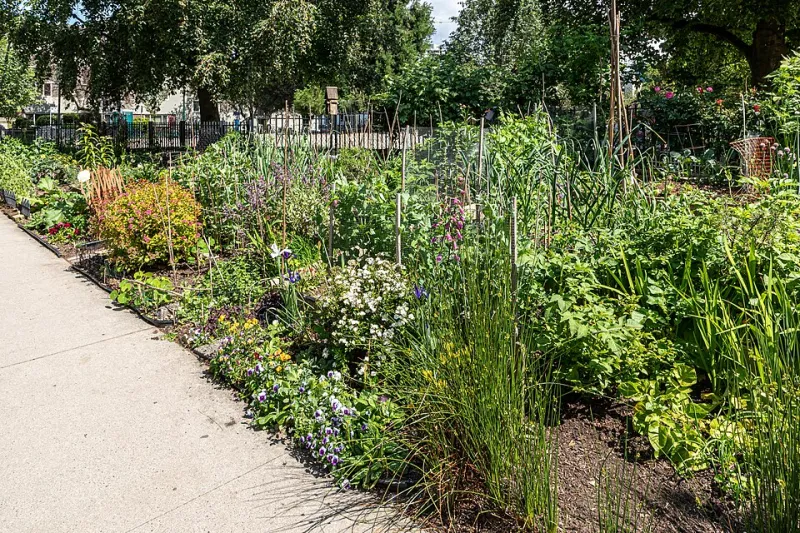
Photo: Dietmar Rabich, CC BY-SA 4.0, via Wikimedia Commons
On a Tuesday morning in late spring, a strip of cracked asphalt that once served as overflow parking for a shuttered retail chain in North Philadelphia is unrecognizable from its former self. Raised beds overflow with collard greens and tomato vines. A hand-painted mural stretches the length of a cinder-block wall. A small lending library—stocked not with books but with hand drills, pipe wrenches, and soil test kits—stands at the corner beneath a corrugated metal awning. Neighbors stop, exchange tools, consult one another about planting schedules. The lot has not been purchased. No permit authorizes its transformation. It has simply been claimed, tended, and made common.
This scene is not anomalous. Across the United States, communities are engaged in what urban planners and civic advocates are increasingly calling a commons movement—a broad, decentralized effort to wrest underused or abandoned land from the logic of private extraction and return it to collective use. From Detroit's expansive network of resident-managed gardens to the pocket plazas of East Los Angeles to the tool-share cooperatives operating out of converted garages in rural Appalachian towns, the pattern is consistent: where institutions have withdrawn and developers have circled, residents are stepping in.
The Political Geography of Abandonment
Understanding why these reclamations are happening requires confronting the conditions that made them necessary. Decades of disinvestment in working-class and communities of color—accelerated by redlining, urban renewal demolitions, and the gutting of municipal maintenance budgets—left vast stretches of American cities dotted with vacant lots, neglected parks, and deteriorating infrastructure. These spaces did not simply fall into disuse by accident. Their abandonment was, in many cases, a deliberate byproduct of policy decisions that prioritized speculative real estate value over community stability.
When a lot sits empty for years, it is rarely because no one wants it. More often, it is because the entity that owns it—a bank, a private equity firm, an absentee landlord—is holding it in anticipation of a more profitable moment. The community surrounding that lot, meanwhile, absorbs the costs: decreased property values, reduced green space, elevated heat in neighborhoods already burdened by urban heat islands, and the social corrosion that comes with visible neglect.
Community organizer and urban land advocate Marisol Vega, who works with a coalition of resident groups in Chicago's South Side, frames it plainly: "Vacant land is never really vacant. It's occupied by someone's financial strategy. When we move in and start growing food or building a stage for performances, we're not filling a void—we're displacing an agenda."
Tools, Seeds, and Stages
The forms that community reclamation takes are as varied as the neighborhoods themselves. Community gardens remain the most visible expression of this movement, and their proliferation over the past decade has been striking. According to the American Community Gardening Association, the number of community gardens in the United States has grown by more than 30 percent since 2012, with the sharpest increases concentrated in urban areas with high rates of food insecurity.
But the movement extends well beyond food production. Tool libraries—cooperative lending programs that allow residents to borrow equipment they could not individually afford—have emerged in dozens of cities as a practical expression of shared resource philosophy. In Portland, Oregon, the East Portland Tool Library has logged tens of thousands of individual loans since its founding, reducing both household expenditure and the environmental cost of redundant manufacturing. Similar programs operate in Minneapolis, New Orleans, and Baltimore, often housed in the same community-controlled spaces that serve as gardens or gathering venues.
Open-air performance spaces represent another dimension of the commons movement with explicitly cultural stakes. In several cities, community organizations have transformed underused lots into amphitheaters, poetry stages, and outdoor classrooms. These spaces serve a dual purpose: they anchor cultural programming that reflects the community's own artistic traditions rather than those curated for outside audiences, and they assert a visible, physical claim to space that might otherwise be eyed by developers.
"When you build a stage, you're saying something very specific about who this place belongs to," says Jerome Alcindor, artistic director of a New Orleans–based nonprofit that has developed three outdoor performance venues in neighborhoods facing intense gentrification pressure. "You're saying: this is where our stories get told, and we're not moving."
The Friction of Formalization
Not all municipal governments are adversarial to these efforts, but the relationship between community-led reclamation and official land-use authority is rarely simple. Cities often occupy an ambivalent middle position—appreciating the civic energy that transforms eyesores into assets while remaining reluctant to cede meaningful control over land that may eventually carry significant development value.
In some jurisdictions, community land trusts have emerged as a legal mechanism for formalizing commons-based stewardship in ways that protect spaces from future privatization. A community land trust holds land in perpetuity on behalf of a community, separating ownership of the land from ownership of any structures or uses on it. This model has been applied to affordable housing for decades, but advocates are increasingly deploying it to protect community gardens, tool libraries, and cultural spaces as well.
The challenge is that formalization, while protective, also introduces bureaucratic complexity that can strain volunteer-led organizations. Permit requirements, liability insurance mandates, and zoning restrictions can transform the simple act of planting a garden or building a lending shelf into a months-long administrative ordeal. Many communities, particularly those with fewer institutional resources, operate in deliberate legal ambiguity—not as a form of recklessness, but as a pragmatic acknowledgment that the formal system was not designed with their participation in mind.
Stewardship as Civic Identity
What distinguishes the most durable of these initiatives is not the particular form they take but the depth of community investment they generate. Spaces that are collectively maintained tend to become sites of broader civic engagement—places where neighbors encounter one another across lines of age, background, and circumstance, and where informal networks of mutual support are quietly constructed.
Research on urban commons consistently finds that shared stewardship of physical space correlates with higher levels of civic participation, stronger social cohesion, and greater collective efficacy—the shared belief that a community can act together to shape its own conditions. In this sense, the community garden and the tool library are not merely amenities. They are civic infrastructure, performing functions that no municipal budget line adequately captures.
This is the argument that commons advocates are increasingly bringing into contact with broader policy debates about land use, housing, and urban development. The reclamation of neglected space, they contend, is not a supplement to formal civic life—it is a form of civic life, one that operates according to values of reciprocity and collective ownership that the dominant market model has systematically crowded out.
The Stakes of Holding Ground
As real estate pressure intensifies in cities across the country, the spaces that communities have worked to transform face growing threat. Lots that were ignored for a decade suddenly attract interest when surrounding property values rise—often, in a bitter irony, because community investment made the neighborhood more desirable. The risk of displacement is not abstract: numerous well-documented cases exist of community gardens demolished to make way for market-rate development, of tool libraries evicted from informal spaces as commercial rents escalate.
Holding ground, in this environment, requires more than good intentions and weekend volunteer hours. It requires legal strategy, political organizing, and the cultivation of allies within municipal government and the philanthropic sector. It requires communities to articulate, in terms that institutional actors can hear, why the commons they have built carries value that no appraisal methodology adequately measures.
But it also requires something more fundamental: the conviction that public space is not a residual category—what's left after private interests have taken what they want—but a primary civic good, one that communities have both the right and the responsibility to define and defend. In neighborhood after neighborhood, that conviction is taking root. The ground has been claimed. The question now is whether it can be kept.