Dollars and Dignity: The Neighbors Rewriting America's Financial Education From the Ground Up

Photo: WeenyBeany, CC BY 2.0, via Wikimedia Commons
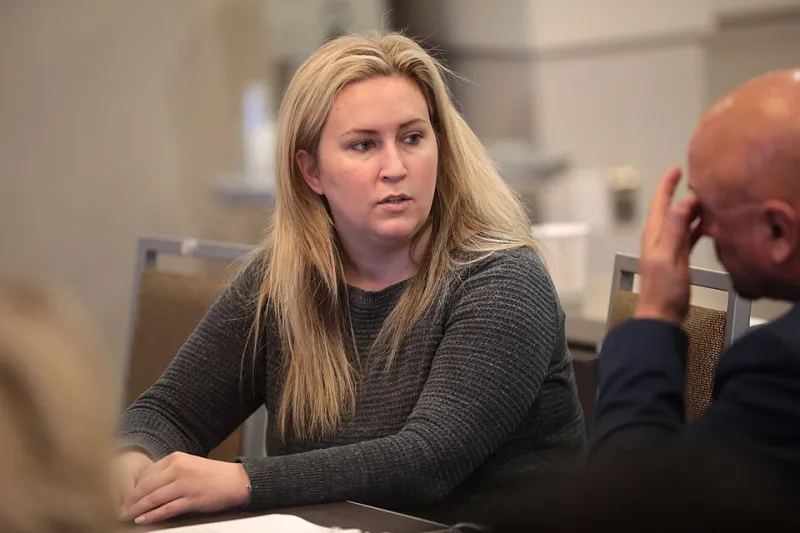
On a Thursday evening in a rented room above a barbershop in West Philadelphia, seven people pull chairs into a loose circle. There are no PowerPoint slides. No certified financial planners in blazers. What there is, instead, is a folding table covered in printed worksheets, a whiteboard with the words "Who does the system serve?" written at the top, and a woman named Darlene who, five years ago, couldn't explain the difference between a credit score and a credit limit.
Today, Darlene facilitates what she calls a "money circle" — a structured but informal gathering where participants dissect their financial lives together, share strategies for navigating debt, and interrogate the structures that made financial precarity so common in their ZIP code in the first place.
"I learned everything I know from someone who learned it the hard way," she says. "And now I pass it on. That's how knowledge is supposed to move."
What Institutions Left Behind
The conventional architecture of financial education in America has long favored those who need it least. High schools in affluent districts are far more likely to offer personal finance courses than those in lower-income communities. Bank-sponsored financial literacy programs — often the default resource in underserved neighborhoods — frequently prioritize product enrollment over genuine empowerment. And the advice dispensed by certified financial advisors is, in practice, accessible primarily to those who already possess meaningful assets.
The result is a vast and largely invisible gap. Millions of Americans navigate decisions about credit, debt, savings, and investment without the conceptual vocabulary to fully understand what they are agreeing to — or what they are being denied. Payday lenders, rent-to-own schemes, and subprime credit products have historically rushed to fill that gap, extracting wealth from communities that formal financial institutions largely ignored.
But something is shifting. Across cities and rural towns alike, a decentralized movement of peer educators is reclaiming the terrain.
Teaching What the Banks Won't
In Chicago's South Side, a mutual aid network called the Bronzeville Financial Collective hosts monthly workshops that go well beyond budgeting basics. Facilitators — most of them community members with backgrounds in social work, small business ownership, or personal recovery from financial hardship — walk participants through the mechanics of credit reporting, the legal rights of debtors, and the structural history of redlining and its contemporary economic consequences.
"We don't just teach people how to survive the system," explains Marcus, one of the collective's founding organizers. "We teach them how the system was designed, who designed it, and why. Because once you understand that, you stop blaming yourself for being in a hard spot."
This emphasis on structural context is a defining feature of grassroots financial education that distinguishes it sharply from mainstream financial literacy programming. Where conventional curricula often frame economic hardship as a product of individual behavior — poor spending choices, insufficient discipline — community-led initiatives are far more likely to situate personal financial struggles within broader histories of policy, discrimination, and institutional neglect.
The pedagogical difference is not merely philosophical. Participants in these circles consistently report that understanding the systemic roots of their financial circumstances reduces shame, increases engagement, and makes them more likely to take concrete action.
Peer Knowledge as Political Act
In Atlanta, a collective of Black women entrepreneurs has built a rotating "investment club" model that blends financial education with collective action. Members contribute small monthly amounts to a shared pool, deliberate together about where those funds should be directed, and simultaneously study topics ranging from index funds and roth IRA contributions to community land trusts and cooperative ownership structures.
"We're learning how money works, but we're also learning how to use money differently," says Priya, a founding member who works as a nurse by day. "The goal isn't just to get wealthy individually. The goal is to understand enough to build something together."
This collaborative orientation — learning not merely to accumulate, but to build collective economic power — reflects a broader sensibility within the grassroots financial education movement. Many of its practitioners are explicit in framing financial literacy not as a path to individual prosperity, but as a prerequisite for community self-determination.
That framing carries real political weight. Communities that understand credit markets, municipal bonds, tax increment financing, and commercial real estate are communities better equipped to engage meaningfully with the economic decisions that shape their neighborhoods — from who gets to open a business on Main Street to whether a developer's proposal serves existing residents or displaces them.
The Curriculum No One Assigned
What do these peer educators actually teach? The content varies considerably by community and facilitator, but several themes appear consistently across the movement.
Debt navigation is nearly universal — not just the mechanics of repayment, but the legal landscape of debt collection, the rights of borrowers under the Fair Debt Collection Practices Act, and strategies for negotiating with creditors. Credit building appears frequently, with particular attention to the ways credit scoring systems can penalize legitimate life circumstances, and the concrete steps individuals can take to rehabilitate damaged scores over time.
Beyond survival-level knowledge, many facilitators are pushing into more advanced territory: the basics of investing, the tax advantages of retirement accounts, the mechanics of homeownership and the hidden costs that mainstream homebuyer education often glosses over. Some circles have begun exploring more transformative economic models — credit unions versus commercial banks, community development financial institutions, worker cooperatives — as part of a broader conversation about what economic alternatives are actually available.
Perhaps most significantly, many of these educators are teaching their peers how to read the fine print — loan agreements, lease terms, credit card disclosures — with the critical eye of someone who understands that clarity is power.
The Limits and the Promise
Grassroots financial education is not without its challenges. Facilitators are largely volunteers working without compensation, and the sustainability of informal learning circles depends heavily on the continued availability and energy of a small number of dedicated individuals. Without institutional support, these networks are vulnerable to burnout and attrition.
There is also the question of accuracy. Peer educators, however well-intentioned, are not always equipped to navigate the most complex corners of tax law, estate planning, or investment regulation. The most responsible facilitators are explicit about the boundaries of their expertise and encourage participants to seek professional guidance for high-stakes decisions.
Yet the limitations do not diminish the significance of what is being built. In a country where financial knowledge has long been distributed along lines of race and class, the emergence of community-led education networks represents something genuinely important: an assertion that economic understanding is not a privilege to be granted by institutions, but a right to be claimed by people.
"Nobody gave us this knowledge," Darlene says, straightening the worksheets at the end of the Thursday session. "We built it ourselves, out of our own mistakes and each other's wisdom. And we're going to keep building it until nobody in this neighborhood has to figure it out alone."
The chairs fold. The whiteboard is erased. And the knowledge, imperfect and hard-won, moves on.