Root Workers and Resisters: How Community Herbalists Are Recovering the Healing Traditions That History Tried to Bury
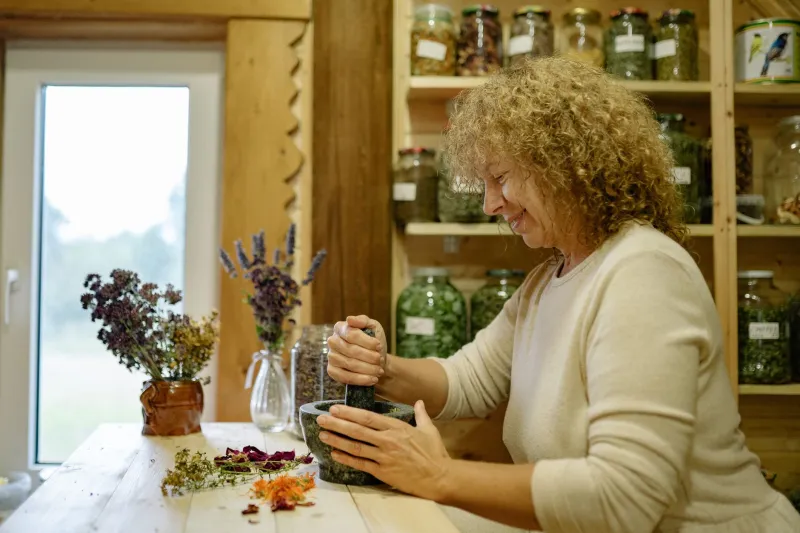
On a late Saturday morning in a community garden on Chicago's South Side, a woman named Delia moves between raised beds with the practiced ease of someone who has made this walk ten thousand times. She pinches a sprig of holy basil—Ocimum tenuiflorum—and holds it beneath the nose of a teenager standing beside her. "Your great-grandmother's grandmother knew this plant," she says. "We're just remembering together."
Delia is one of dozens of community herbalists across the country quietly rebuilding something that was never supposed to survive: a living, intergenerational body of botanical healing knowledge rooted in African American, Latinx, and Indigenous traditions. Their work unfolds in community gardens, church basements, and borrowed classrooms—spaces that exist largely outside the institutional frameworks of American medicine. That distance, many of them argue, is not incidental. It is the point.
What Was Taken, and How
The suppression of traditional plant medicine in America was not accidental. It was policy.
For enslaved African Americans, plant knowledge was simultaneously a survival technology and a site of terrifying vulnerability. Healers who understood which roots could reduce fever, which barks could ease childbirth, or which preparations could resist infection were essential to their communities—and deeply threatening to the systems that sought to control those communities. Across the antebellum South, laws explicitly criminalized the practice of medicine by enslaved people, and accusations of poisoning were wielded against Black healers as instruments of terror.
Indigenous botanical traditions faced parallel destruction. Federal assimilation policies banned ceremonial practices, removed children from communities that carried healing knowledge, and systematically dismantled the social structures through which plant wisdom was transmitted. For Latinx communities, the curandera tradition—a rich synthesis of Indigenous, African, and Spanish healing practices—was marginalized through the twentieth century as unscientific at best and dangerous at worst.
The professionalization of American medicine in the early twentieth century, driven in large part by the 1910 Flexner Report, consolidated medical authority in institutions that were overwhelmingly white, male, and exclusionary. What that consolidation left behind was not merely folk custom. It was a sophisticated, community-tested pharmacopeia that had sustained generations.
"We didn't lose this knowledge because it didn't work," says Marcus, a New Orleans–based herbalist and educator who runs a community apprenticeship program. "We lost it because losing it served someone else's interests."
The Archive in Living Hands
The recovery effort now underway takes many forms, but its most essential feature is its insistence on transmission through relationship rather than institution.
In East Los Angeles, a collective of Latinx herbalists called Raíces Vivas—Living Roots—has spent the past six years documenting plant knowledge held by elders in their community, many of whom learned from family members who crossed the border carrying seeds and stories. The collective hosts monthly plant walks, maintains a seed library of medicinal species, and runs a year-long apprenticeship for young people from the neighborhood. Crucially, their curriculum treats botanical knowledge not as a supplement to Western medicine but as an independent epistemological tradition deserving of equal intellectual respect.
"We are not trying to become alternative medicine," explains one of the collective's co-founders. "We are trying to remember that we were always medicine."
In the Southeast, several practitioners working within the African American root-work tradition have begun formalizing what was once transmitted exclusively through family and community lineage. They are creating written archives, audio recordings, and illustrated guides—not to bureaucratize the tradition, but to protect it against the mortality of its living holders. One herbalist in Atlanta describes the project as "building a library that belongs to the neighborhood, not to a university."
On several reservations in the Southwest, tribal members are partnering with younger community members to restore medicinal plant gardens that were allowed to lapse during decades of displacement and resource deprivation. These gardens serve a dual purpose: they are both functional healing resources and pedagogical spaces where traditional ecological knowledge can be practiced rather than merely described.
Between Healing and Criminalization
The legal and regulatory landscape surrounding community herbalism remains treacherous. Federal and state laws governing the practice of medicine are written in ways that, whether by design or effect, treat traditional plant healing as suspect. Herbalists who charge for their services risk prosecution for practicing medicine without a license. Those who make specific health claims about their preparations face regulatory action from the Food and Drug Administration.
The result is a system that protects the commercial interests of pharmaceutical manufacturers while rendering community healers legally precarious—even when those healers are serving populations that mainstream medicine has historically failed or ignored.
"The communities we work with have some of the worst health outcomes in this country," Marcus observes. "And the response from the system has been to make it harder for the healers those communities already trust to do their work."
Advocacy organizations are beginning to push back. Several progressive health equity coalitions have called for regulatory reforms that would create protected space for traditional healing practices, drawing on legal frameworks developed in other countries that recognize indigenous and community medicine as legitimate health systems. The movement is nascent, but it is growing.
Seeds as Sovereignty
Perhaps no element of this work is more symbolically charged than the seed libraries that many community herbalists maintain. Seeds are, in the most literal sense, the material carriers of botanical knowledge—each one encoding information about soil, climate, use, and history that no written text can fully replicate.
For communities whose agricultural and healing traditions were disrupted by forced migration, displacement, and assimilation pressure, the act of maintaining and distributing medicinal plant seeds carries a weight that transcends horticulture. It is a declaration that the knowledge has not been extinguished. That it can be passed forward. That the community retains the authority to tend its own health.
Delia, back in her South Side garden, understands this instinctively. She presses a small paper envelope into the teenager's hand. Inside are seeds from a plant her own mentor gave her fifteen years ago. "You don't have to know everything right now," she tells him. "You just have to keep the seed alive."
The Purpose Beneath the Practice
What distinguishes community herbalism from wellness trends or the boutique botanical market that has flourished in recent years is its explicit grounding in justice. These practitioners are not offering plant medicine as a luxury or a lifestyle choice. They are offering it as a form of sovereignty—a declaration that communities historically denied access to health resources have both the right and the capacity to generate those resources themselves.
In that sense, the work of the community herbalist is inseparable from the broader project of cultural preservation and civic resistance that defines so much of what is most vital in American grassroots life. It is, at its core, an argument about who gets to be a keeper of knowledge, and who gets to say what healing looks like.
The garden, in this light, is not merely a garden. It is a classroom, an archive, a clinic, and an act of defiance—rooted in soil that remembers everything.