Fables of the People: How Grassroots Communities Are Forging New Myths to Reclaim Their Own Futures
For as long as human beings have gathered around fires — literal or figurative — stories have determined who belongs, who leads, and what a community believes it deserves. In the United States today, a growing number of grassroots organizations have arrived at a quietly radical conclusion: the stories being told about their communities were written by someone else, for someone else's purposes. And they intend to change that.
From the South Side of Chicago to the colonias of South Texas, from immigrant enclaves in the Pacific Northwest to historically Black neighborhoods in Atlanta, community groups are engaging in what some scholars and organizers are beginning to call collective mythmaking — the deliberate, participatory construction of shared narratives that center a community's own values, ancestors, struggles, and visions of the future.
This is not nostalgia. It is not folklore preservation in the traditional archival sense. It is something more urgent and more intentional: the creation of new stories, rooted in lived experience, designed to build solidarity and expand the boundaries of what a community can imagine for itself.
The Problem With Inherited Narratives
Every community absorbs stories from the broader culture. Some of those stories are affirming. Many are not. Communities of color, immigrant communities, working-class communities, and Indigenous communities in America have long contended with dominant narratives that cast them as problems to be solved, populations to be managed, or histories to be footnoted rather than centered.
The consequences are not merely symbolic. Research in social psychology has consistently demonstrated that the stories people internalize about their own groups shape their expectations, their ambitions, and their collective behavior. When a neighborhood is described primarily through the language of deficiency — crime rates, poverty indices, failing schools — residents absorb that framing even as they resist it. The dominant story becomes a kind of gravitational force.
Organizations engaged in collective mythmaking are attempting to generate a counter-gravity. They are building new origin stories not to deny hardship, but to situate hardship within a larger arc of agency, resilience, and possibility.
Storytelling Circles as Democratic Infrastructure
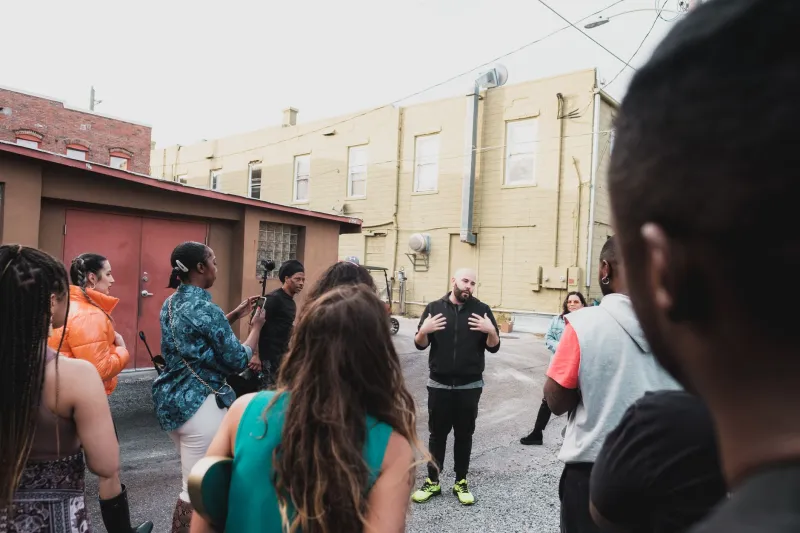
In East Oakland, California, a nonprofit called Narrative Commons hosts monthly storytelling gatherings in community centers, barbershops, and church fellowship halls. Participants — ranging from longtime residents in their seventies to teenagers who grew up entirely in the social media era — are invited to contribute to an evolving community mythology that the organization calls "the Oakland Codex."
The Codex is not a fixed document. It grows through collective contribution, incorporating folk tales, personal testimonies, invented fables, and reinterpreted historical episodes. A grandmother's account of the 1966 founding of the Black Panther Party becomes a creation myth. A teenager's story about defending a mural from being painted over becomes a parable about stewardship. The ordinary is elevated into the emblematic.
"We are not trying to romanticize poverty or struggle," explains one of the project's lead facilitators. "We are trying to say: here is what our people have done with what they were given. Here is what we value. Here is the world we are building toward. That is what a myth does — it tells you who you are and points you toward who you could become."
Similar circles have taken root in communities across the country, each with its own texture and method. In Minneapolis, a Somali-American arts collective facilitates intergenerational storytelling sessions that weave Somali oral traditions into narratives about navigating American civic life. In rural Appalachia, a community organization is working with residents to reclaim regional folk traditions that have long been caricatured by outside media, reauthoring those traditions from the inside.
The Graphic Novel as Community Scripture
Perhaps nowhere is the collective mythmaking impulse more visually striking than in the community-authored graphic novel projects proliferating in urban neighborhoods across the United States.
In the Pilsen neighborhood of Chicago — a predominantly Mexican-American community with a storied tradition of public muralism — a coalition of local artists and educators spent eighteen months collaborating with more than two hundred residents to produce a graphic novel titled The Serpent and the Skyline. The story follows a young woman who discovers that the neighborhood's founding families left behind a series of encoded messages in the area's murals, messages that contain instructions for resisting gentrification and preserving cultural continuity.
The narrative is fictional. The stakes it describes are entirely real.
"We wanted something that children could read, that grandparents could recognize themselves in, and that outsiders could not fully decode," said one of the project's lead illustrators. "A myth belongs to the people who made it. It is not for everyone. It is for us."
The project drew on techniques from community-based participatory research, design thinking, and Indigenous storytelling methodology. Residents voted on plot decisions, contributed characters drawn from neighborhood history, and debated the moral lessons embedded in the story's resolution. The finished work was printed in both English and Spanish and distributed free of charge throughout the neighborhood.
Since its release, The Serpent and the Skyline has become something of a local touchstone — referenced at community meetings, quoted in tenant organizing materials, and displayed in the windows of small businesses alongside the murals that inspired it.
Mythology as Political Imagination
There is a reason that political movements across history have understood the power of shared stories. Mythology does not merely describe a community's past — it prescribes its future. The stories a group tells about itself determine, in no small measure, what that group believes it is entitled to demand.
Organizers working in collective mythmaking are explicit about this dimension of their work. The goal is not entertainment, though the stories are often genuinely compelling. The goal is what theorists of social change sometimes call "prefigurative politics" — the practice of enacting, within the present, the values and relationships one wishes to see institutionalized in the future.
When a community gathers to author a shared mythology, it is also practicing democratic deliberation. It is negotiating shared values. It is deciding, collectively, which ancestors to honor, which struggles to commemorate, and which visions to pursue. The story becomes a rehearsal for the world the community intends to build.
Reclaiming the Right to Be Complex
One of the most consistent themes across these projects is the insistence on complexity. Communities engaged in collective mythmaking are not producing propaganda — they are not replacing one flattened narrative with another. The stories that emerge from these processes tend to hold contradiction, to honor ancestors while acknowledging their failures, to celebrate resilience without erasing grief.
This complexity is itself a form of resistance. Dominant narratives often reduce communities to a single story: the struggling neighborhood, the grateful immigrant, the resilient survivor. Collective mythmaking insists on the full range of human experience — the comedy alongside the tragedy, the ordinary alongside the extraordinary, the mundane alongside the sacred.
In doing so, these communities are asserting something that ought to be self-evident but has too rarely been honored in American public life: that their interior worlds are as intricate and worthy of serious artistic attention as any other.
The Work Continues
The storytelling revolt, if it can be called that, is neither centrally organized nor ideologically uniform. It encompasses secular humanists and devout believers, lifelong activists and political newcomers, communities with deep roots in American soil and communities newly arrived. What unites these efforts is a shared conviction that narrative power is real power — and that communities which cede the right to tell their own stories cede something essential about their capacity for self-determination.
For those who have long understood that culture is not separate from politics but is, in fact, its deepest foundation, this moment feels less like a new development than a return to something ancient. Stories built the world. Stories can rebuild it.
The question these communities are asking — and answering, one gathering at a time — is not whether stories matter. It is who gets to tell them.