Stitched in Common: How Craft Circles Are Becoming Classrooms of Conscience and Connection
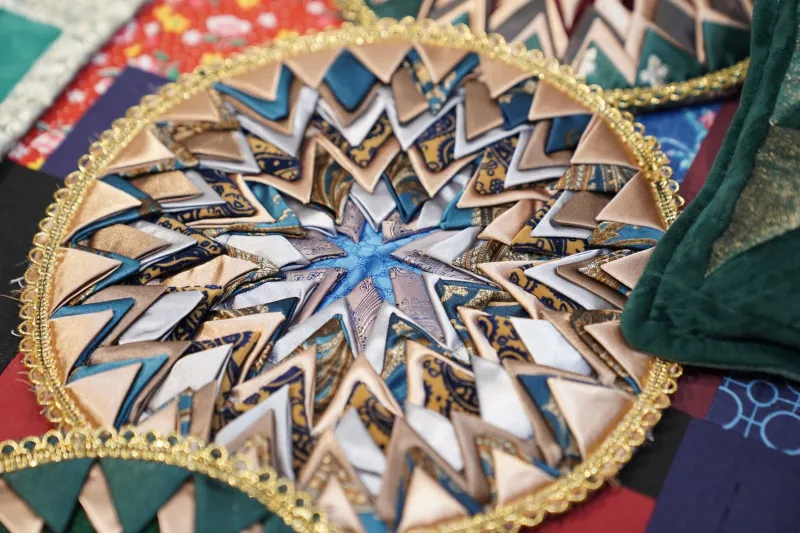
The nine women seated around the long oak table in a community room in Jackson, Mississippi, range in age from twenty-two to seventy-eight. Between them, spread across the table's surface, lies a quilt in progress — a patchwork of deep indigo, burnt orange, and cream, each hexagonal piece cut from fabric that someone in the room donated, carried, or inherited. The youngest participant, a college student named Zora, is working on her first quilt block. The oldest, Miss Evelyn, has been making quilts for more than five decades. They are not simply sewing. They are talking — about the 2020 election, about what happened to Evelyn's nephew last spring, about what it means to make something with your hands that will outlast you.
"There's something about having your hands busy that opens your mouth in a different way," says Marilyn Tate, who founded the Magnolia Stitch Collective four years ago. "People say things here they wouldn't say in a town hall or a church meeting. The needle gives you permission."
Across the United States, a quiet but consequential revival is underway in the world of fiber arts. Quilting bees, embroidery circles, knitting groups, and weaving collectives are being reconstituted — not as quaint throwbacks to a simpler era, but as deliberate, politically conscious spaces for the kind of slow, embodied connection that digital culture has struggled to provide. These gatherings are becoming, in the words of one organizer, "the meeting after the meeting" — places where the emotional and intellectual work of civic life gets done.
Craft as Inheritance, Craft as Resistance
To understand why fiber arts carry such particular weight as vehicles for political and cultural work, it helps to reckon with their history. Quilting, especially within Black American communities, has long been a practice that carried more than warmth. The quilts of Gee's Bend, Alabama — now recognized as masterworks of American art — were made by women whose hands had also picked cotton, whose labor had been stolen, whose stories had been systematically excluded from the official record. Their quilts were acts of aesthetic sovereignty as much as domestic necessity.
That tradition of craft-as-resistance is being consciously invoked by many contemporary collectives. In Oakland, the Bay Area Solidarity Stitchers have produced a series of embroidered banners carried at housing rights demonstrations, each panel depicting a neighborhood displaced by gentrification. In Minneapolis, the North Side Quilters Guild has created a community memory quilt documenting residents' experiences during the summer of 2020, a textile archive that now tours libraries and community centers.
"We were taught that quilting was women's work, meaning it was invisible work," says Paulette Harris, a founding member of the North Side guild. "We're reclaiming it as political work, as historical work, as work that says: we were here, and here is what we made of what happened to us."
The Intergenerational Thread
One of the most striking features of the contemporary craft circle revival is its explicit investment in intergenerational exchange. Many of these groups are deliberately structured to bring together elders who carry traditional skills with younger participants who bring political urgency and fresh perspectives — creating a dynamic that enriches both.
In Brooklyn, the Brownsville Fiber Arts Collective pairs teenage participants from a local youth center with women in their sixties and seventies who learned to sew from their own mothers and grandmothers. The exchange is not simply technical. It is cultural and emotional, a negotiation between lived histories and emerging identities.
"My grandmother never talked about the civil rights movement directly," says Aisha Coleman, a nineteen-year-old participant. "But when we're sewing together, she tells me things. About what it felt like to integrate her school. About what she was afraid of. I don't think she'd tell me those things sitting across a dinner table."
This phenomenon — what some researchers have called "sidelong conversation," the way shared physical activity enables disclosures that direct eye contact inhibits — is increasingly being recognized by educators and therapists as a meaningful modality for intergenerational dialogue. The craft circle, in this reading, is not incidental to the conversation. It is the condition that makes the conversation possible.
Political Consciousness Through the Needle
Beyond healing and memory, many of these collectives are explicitly framing their work as political education. Some have integrated readings and discussions of social theory, history, and current events into their gatherings. Others have partnered with community organizations to orient their craft production toward specific advocacy goals.
The Threads of Justice Collective in Tucson, Arizona, holds monthly "stitch-and-learn" sessions that combine embroidery instruction with presentations from local organizers, immigration attorneys, and environmental justice advocates. Participants work on collaborative textile pieces whose imagery reflects the political themes under discussion.
"We're not pretending that making a beautiful thing changes policy," says collective co-founder Luz Morales. "But we are saying that the kind of attention, patience, and care that craft requires — those are also the qualities that sustain long-term organizing. You practice them here, and you carry them out there."
This argument — that craft cultivates civic virtues — is not merely rhetorical. Several participants in collectives across the country describe the experience of sustained, collaborative making as having fundamentally altered their relationship to community and to political engagement. The slow accumulation of small stitches, they say, offers a felt alternative to the instant-gratification logic of social media activism, a reminder that meaningful change is built incrementally, by many hands, over time.
Making Space for Grief and Imagination
Craft circles are also emerging as spaces where communities process grief — over lost elders, over neighborhoods transformed beyond recognition, over political defeats that leave deep marks. The act of making something beautiful in the aftermath of loss is, in many traditions, a form of mourning practice. Contemporary collectives are recovering and adapting that tradition.
In New Orleans, a quilting collective formed in the wake of Hurricane Katrina has been meeting for nearly two decades, its membership shifting as the city has changed but its core purpose — to hold memory, to honor loss, and to insist on the community's continued existence — remaining constant.
"Every quilt we make has somebody's story in it," says collective elder Ruth Tureaud. "Somebody's kitchen curtains. Somebody's church dress. Somebody's baby blanket. We're not just making quilts. We're making proof."
Proof of presence. Proof of persistence. Proof that even in the face of erasure, communities find ways to stitch themselves back together — literally and otherwise. In the revival of America's craft circles, what is being reclaimed is not simply a set of traditional skills. It is a way of being together: slow, attentive, generative, and unafraid of the difficult conversations that arise when hands are busy and hearts are open.